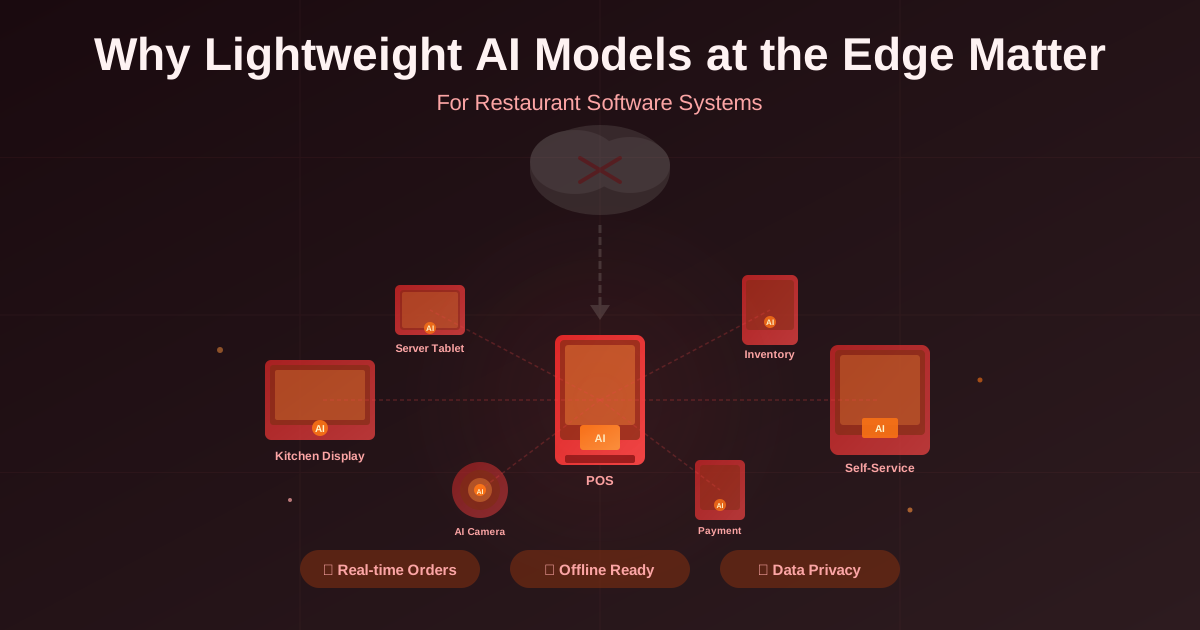
Why Lightweight AI Models at the Edge Matter

The New Blueprint for Retail, POS, and Restaurant Workloads
In 2026, the digital storefront has evolved. Real-time interaction, sub-10ms latency, and "Zero-Trust" offline reliability are no longer "nice-to-have" features—they are the baseline for survival in retail and hospitality.
While massive Cloud LLMs handle the "brain" of a corporation, it is the Lightweight Edge Model that acts as the "nervous system" on the front lines. Here is how Google’s latest AI ecosystem is redefining edge operations.
The Edge Imperative: Beyond the Round-Trip
Traditional cloud-centric AI introduces a "latency tax." In a Quick Service Restaurant (QSR) or high-volume retail environment, waiting 500ms for a cloud inference to authorize a contactless payment or verify an item in a cart is an operational failure.
The Solution: Shifting from "Cloud-Inference" to "Edge-Native Execution." By running models locally on Google Distributed Cloud (GDC) Edge, businesses eliminate the dependency on wide-area networks (WAN), ensuring that even if the store’s fiber line is cut, the AI-powered checkout stays live.
What “Lightweight” Means in 2026
We have moved past simple regression models. Today’s lightweight AI refers to Small Language Models (SLMs) and Vision Transformers (ViT) optimized for NPU (Neural Processing Unit) acceleration.
- Gemma 3 (270M & 4B): Google’s latest open-weights models are designed specifically for the edge. The 270M parameter version is small enough to run on a smart POS terminal while providing complex reasoning for customer service.
- LiteRT (Formerly TensorFlow Lite): The industry-standard runtime for 2026. It allows these models to tap directly into specialized AI silicon on-site, providing near-instant results.
- Quantization & Pruning: Using Vertex AI Optimization tools, models are compressed from 16-bit to 4-bit precision, reducing memory footprint by 75% without sacrificing operational accuracy.
The Google Stack: Vertex AI + GDC Edge
The modern architecture splits the labor: Vertex AI is the factory; GDC Edge is the storefront.
1. Vertex AI: Train Big, Distribute Small
Vertex AI now acts as a centralized "Model Garden" where you can:
- Distill Knowledge: Take a massive Gemini 1.5 Pro model and "distill" its knowledge into a tiny Gemma 3 model tailored for your specific menu or inventory.
- Edge-Ready Packaging: Vertex now automates the creation of LiteRT artifacts, ensuring the model is pre-optimized for the specific hardware (e.g., NVIDIA L4 GPUs or Coral TPUs) inside your stores.
2. GDC Edge: The On-Premises Powerhouse
Google Distributed Cloud (GDC) brings Google’s infrastructure into the physical restaurant or store.
- Local Inference: It hosts the LiteRT runtime locally.
- Sovereign Data: Customer video feeds for "Heatmap Generation" or "Queue Detection" stay on the local GDC appliance, satisfying strict 2026 data residency and privacy regulations.
2026 Use Cases: Retail & Restaurants
🔹 Intelligent POS & Vision-Based Checkout
Using Gemma 3 Vision, POS systems can now recognize non-barcoded items (like organic produce) or identify "sweethearting" (when items aren't scanned) in real-time. Because it happens at the edge, the alert is triggered before the customer leaves the kiosk.
🔹 Voice-First Drive-Thrus
Edge-native Speech-to-Text (STT) and NLU (Natural Language Understanding) allow drive-thrus to process complex orders in noisy environments without cloud lag.This improves "car-to-curb" times—a metric that directly dictates QSR profitability.
🔹 Agentic Inventory Management
Instead of simple alerts, lightweight agents on-site can compare real-time shelf imagery against local stock databases. If a "stock-out" is detected, the Gemma-based agent can automatically draft a restock request for the manager to approve.
Final Thoughts
The future of retail isn't found in a distant data center—it’s tucked under the counter and mounted on the ceiling. By combining Vertex AI’s training power with GDC Edge’s local execution, businesses are building "Living Stores" that are faster, more private, and incredibly resilient.
The Edge is no longer an outlier; it is the engine of the modern customer experience.