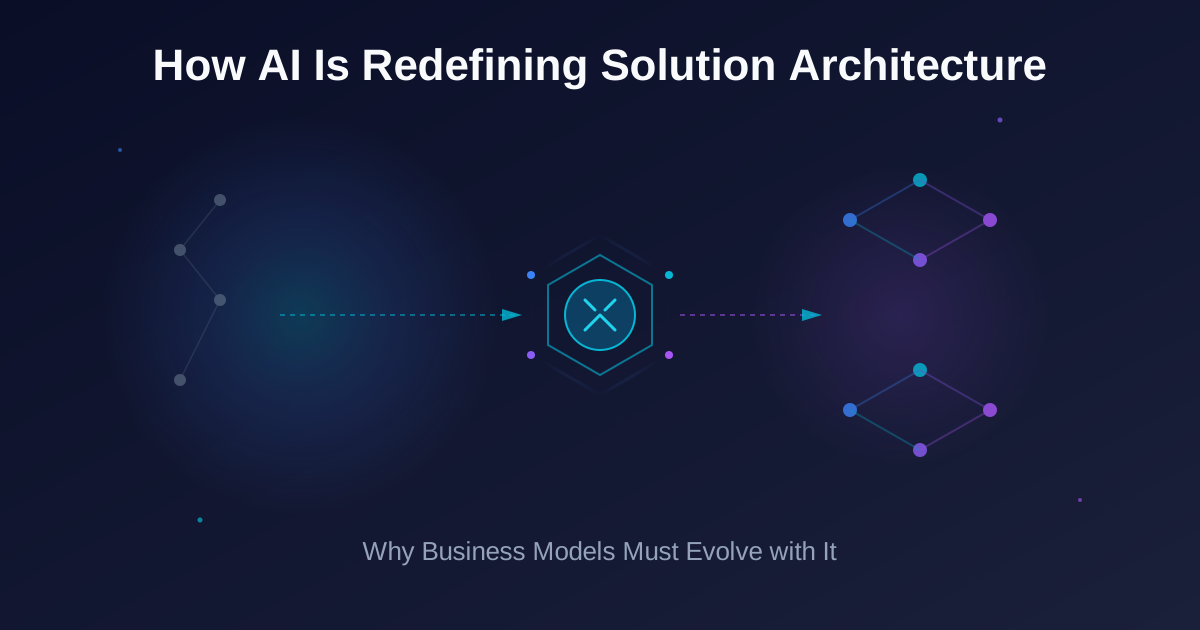
How AI Is Redefining Solution Architecture — and Why Business Models Must Evolve with It

For decades, solution architecture has focused on designing systems around well-defined processes, deterministic workflows, and predictable user interactions. Enterprises invested heavily in layered architectures, service orchestration, and integration patterns that assumed humans were the primary decision-makers and software systems were execution engines.
AI fundamentally breaks this assumption.
Artificial intelligence—especially modern ML, generative AI, and agentic systems—is not just another technology layer to be “plugged into” existing architectures. It changes how decisions are made, how work is executed, and how value is created. As a result, solution architecture must evolve—and so must the business models and processes it supports.
This is not a tooling shift. It is an architectural and economic shift.
From Deterministic Systems to Probabilistic Intelligence
Traditional enterprise systems are deterministic by design. Given the same input, they are expected to produce the same output every time. Business rules are explicit, workflows are predefined, and success is measured by consistency and efficiency.
AI systems behave differently.
AI introduces probabilistic outcomes, adaptive behavior, and continuous learning into the core of enterprise solutions. Instead of encoding every rule upfront, systems infer intent, predict outcomes, and recommend or act based on likelihoods rather than absolutes.
This forces architects to rethink foundational assumptions:
- Decisions are no longer binary; they are confidence-based
- Outputs may vary based on context, data freshness, and model behavior
- Systems improve over time rather than remaining static
Solution architecture must therefore shift from designing rule-driven pipelines to intelligence-driven systems that can reason, adapt, and collaborate with humans.
AI as a First-Class Architectural Component
In many organizations today, AI is treated as an add-on—an API call, a chatbot, or a model wrapped behind a microservice. This approach limits AI’s potential and creates architectural friction.
In AI-native architectures, intelligence becomes a first-class component:
- Models are part of the core system, not the edge
- Data pipelines are designed for learning, not just reporting
- Feedback loops are explicit architectural elements
- Systems are designed to observe, reason, act, and learn
This leads to new architectural concerns that did not exist before:
- Model lifecycle management alongside application lifecycle
- Data quality, lineage, and bias as architectural risks
- Latency trade-offs between real-time inference and batch learning
- Explainability and governance embedded into solution design
Architects must now design for learning systems, not just scalable systems.
The Rise of Agentic Architectures
One of the most disruptive shifts enabled by AI is the emergence of agentic architectures—systems composed of autonomous or semi-autonomous agents that can plan, reason, and execute tasks toward a goal.
Unlike traditional services that respond to direct requests, agents:
- Interpret intent rather than commands
- Break goals into sub-tasks dynamically
- Interact with tools, APIs, and other agents
- Adapt strategies based on outcomes and feedback
From an architectural standpoint, this changes everything:
- Control flow becomes decentralized
- Orchestration gives way to coordination
- Systems become goal-driven rather than process-driven
Agentic AI forces architects to rethink boundaries between applications, workflows, and users. In many cases, the “application” becomes a collection of intelligent agents collaborating across systems.
Why Business Models Must Be Revisited
When architecture changes, business models inevitably follow.
Most enterprise business models are built around assumptions such as:
- Human labor is the primary driver of value
- Software automates tasks, not decisions
- Productivity scales linearly with headcount or licenses
AI challenges these assumptions.
With AI, value increasingly comes from:
- Decision quality rather than execution speed
- Automation of cognitive work, not just manual tasks
- Continuous optimization rather than static efficiency
This enables entirely new business models:
- Outcome-based pricing instead of time or license-based pricing
- AI-powered advisory services delivered at scale
- Dynamic pricing, personalization, and real-time optimization
- “Always-on” digital workers operating alongside humans
Organizations that keep legacy business models while adopting AI often fail to capture its real value. Architecture and business strategy must evolve together.
Rethinking Processes in an AI-Driven Enterprise
Enterprise processes today are designed around human constraints—approval chains, handoffs, and static roles. AI removes or reshapes many of these constraints.
In AI-enabled processes:
- Decisions can be made continuously, not periodically
- Exceptions can be handled intelligently, not escalated blindly
- Processes become adaptive rather than rigid
This means solution architects must collaborate closely with business leaders to redesign processes—not just automate existing ones.
Key shifts include:
- From approval-based workflows to confidence-based thresholds
- From static roles to human–AI collaboration models
- From retrospective analytics to real-time decisioning
If processes remain unchanged, AI becomes an expensive automation layer. If processes are redesigned, AI becomes a force multiplier.
Data, Context, and RAG as Architectural Foundations
Modern AI systems are only as good as the context they operate in. This is where architectures like Retrieval-Augmented Generation (RAG) become critical.
RAG architectures allow AI systems to:
- Ground responses in enterprise data
- Combine reasoning with factual retrieval
- Adapt to changing knowledge without retraining models
From an architectural perspective, this elevates:
- Knowledge stores to first-class system components
- Search, embeddings, and vector databases as core infrastructure
- Context assembly as a design responsibility
RAG is not just a GenAI pattern—it is a bridge between enterprise systems of record and intelligent systems of action.
The New Role of the Solution Architect
As AI reshapes systems and business models, the role of the solution architect must evolve as well.
Architects are no longer just system designers. They become:
- Translators between AI capabilities and business strategy
- Designers of human–AI interaction models
- Stewards of trust, governance, and ethical use
- Builders of platforms that can evolve continuously
The most effective architects in the AI era will be those who can think across technology, process, and economics—not in isolation, but as a unified system.
Looking Ahead
AI is not replacing solution architecture—it is elevating it.
But this elevation comes with responsibility. Enterprises that simply “add AI” to existing architectures will see incremental gains at best. Those that rethink architecture, business models, and processes together will unlock exponential value.
The future belongs to organizations that design for intelligence from the ground up.
And the role of the architect has never been more critical.